
Bayanan is not a place most visitors expect to meet in a Puerto Galera travel brochure. The town’s modern reputation is for beaches, dive boats and weekend tourism. Yet beneath its present surface, material recovered and examined in the 1960s tells a quieter, older story: fragments of pottery and porcelain, burial material, and evidence that people here participated in long‑distance exchange with China and other parts of Southeast Asia centuries before the Spanish arrived.
The primary published source for these finds is a short study titled “A Visit to Puerto Galera” by Rosa C. P. Tenazas and Leonisa L. Ramas, published in 1964. The authors examined trade pottery held in the collection of Fr. Erwin Thiel, S.V.D., who was then parish priest of Puerto Galera. Tenazas and Ramas identified Bayanan as the principal source area for much of the pottery and named Minolo as another important site associated with the collection.
Tenazas and Ramas described a range of imported ceramics — which the authors suggested might include wares dating from periods such as the Tang through the early Ming dynasties — and noted that some of these trade potteries were recovered from burial contexts. Alongside those imported pieces, they recorded at least nineteen types of local native pottery. The combination of foreign and indigenous ceramics has direct implications for how researchers read social life and ritual practice in pre‑Spanish Puerto Galera.
Archaeologists treat broken pottery shards as voices from the past. Imported sherds help document trade networks and foreign contact; when such items appear in burials, they also speak to ritual meaning, social value and how communities treated the dead. The Bayanan evidence therefore does more than show objects moving between ports — it indicates how those objects were incorporated into local cultural life.
Understanding Bayanan requires imagining the wider economic and ecological world behind the finds. The contextual notes cited by Tenazas and Ramas refer to trade in glazed porcelains exchanged for local products such as gold, jade, coral, shells, birds, rattan and other forest goods. That list suggests connections that ran from reef to mountain: maritime merchants trading with coastal and upland communities that supplied forest products and commodities.
There is a poignancy to the image of an imported bowl placed with the dead. An object made far away travels by ship, becomes part of daily life, and ultimately is placed in a grave. Centuries later the bowl may lie broken in the earth even as names, languages and rulers have changed. It is this persistence of material culture that makes Bayanan an important locus for remembering people who left little in written records.
At the same time, the Bayanan story raises cautionary points. Tenazas and Ramas’ report relied on material kept in a private collection and on fragments reconstructed after removal from the ground. Across the Philippines, uncontrolled digging, collecting and treasure hunting have disturbed burial sites and destroyed archaeological context. When artifacts are removed without systematic excavation and recording, associations between objects, their positions and accompanying materials — the very things that allow archaeologists to build reliable histories — can be lost.
The collection assembled by Fr. Erwin Thiel likely preserved pieces that might have otherwise disappeared, yet it also highlights a tension: rescued objects can lack the full context needed for detailed interpretation. For that reason, Tenazas and Ramas — and later commentators referenced in bibliographic listings — argue for more careful documentation, mapping and community reporting to protect remaining sites and recover knowledge properly.
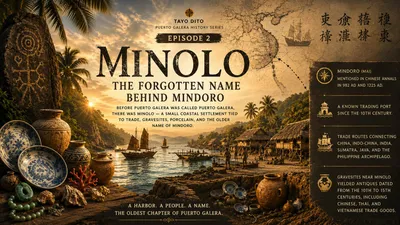
Bayanan and Minolo therefore operate as complementary doors into Puerto Galera’s past: Minolo as a remembered harbour in older name traditions and early historical references, Bayanan as the place where the earth kept physical evidence. Together they suggest a landscape of shorelines, coves, trading nodes and burial places that connected Mindoro into a broader pre‑modern maritime network.
For local stewards and readers, the lessons are practical. Material culture beneath our feet can outlast names and records and tells stories of local agency and wide connections. But saving objects matters only when context is preserved as well. Future heritage work in Puerto Galera should prioritise careful recording, mapping and community engagement so that the ground’s memory can be read, not merely collected.
Tip or correction?
The Tayo Dito team reviews corrections and extra tips before publication.
Comments
0 comments
No comments yet.
Write the first note. It becomes visible after editorial approval.