
Before it became a resort town, before White Beach, before dive boats and ferry schedules, before Spanish ships found shelter in Muelle Bay, Puerto Galera already belonged to the sea.
Its oldest story is not Spanish. It is older, wider, and more mysterious. It begins with trade winds, forest goods, burial sites, Chinese ceramics, coastal settlements, and indigenous communities living between the mountains and the water. It begins with a place remembered as Minolo.
Today, many people know Puerto Galera through its beaches. But the first important “tourists” of this coast were not vacationers. They were sailors, traders, boatmen, merchants, and navigators moving through the old maritime highways of Asia.
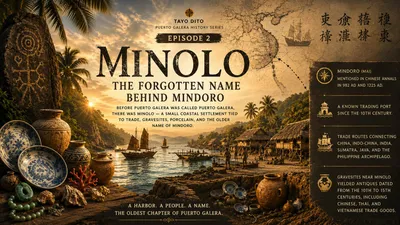
Official Oriental Mindoro tourism history says Puerto Galera was known to seafarers as a trading port from around the 10th century. It places the town along routes connecting China, the Indo‑Chinese coast, the Indian coast, Sumatra, Java, and other parts of the Philippine archipelago.
That is a much bigger story than a postcard. It means that long before Spain arrived, northern Mindoro was not a forgotten island at the edge of the map. It was part of a moving sea‑world. Boats came and went. Goods changed hands. Foreign ceramics arrived. Local products left. The coast was already connected.
And Minolo may have been one of the keys. Oriental Mindoro’s tourism history connects the name “Mindoro” to Minoro, sometimes spelled Minolo, described as a small coastal settlement northwest of today’s poblacion of Puerto Galera. By the 16th century, references to Mindoro often meant the harbor of Minolo, described as a center of trade between Chinese merchants and local people.
What did they trade? The old exchange sounds almost like a cargo list from a forgotten adventure film: glazed porcelain from Chinese merchants, exchanged for local gold, jade, corals, shells, birds, rattan, and forest products from Mindoro. No hotel bookings. No beach umbrellas. No souvenir shirts. Just porcelain, gold, reef, forest, and wind.
Archaeological evidence strengthens the story. In 1964, Rosa C. P. Tenazas and Leonisa L. Ramas studied trade potteries from Puerto Galera. Their work, preserved in the University of the Philippines repository, described evidence of around 600 years of trade relations with China and other parts of Southeast Asia. Some of the pottery may date from the Tang dynasty period through the early Ming period.
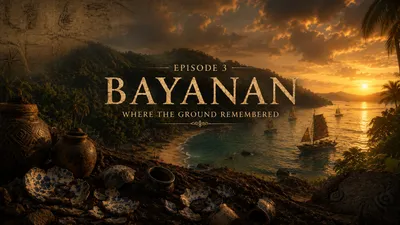
Two places stand out: Bayanan and Minolo. According to the same study, Bayanan was the principal site from which much of Fr. Erwin Thiel’s pottery collection came, while Minolo was identified as another major site. The study also describes coastal burial‑site areas and native pouring vessels comparable to finds from Calatagan, Batangas.
That detail matters. Because this was not simply trade. It was life and death. The ceramics were not only objects brought by foreign merchants. Some were connected to burial sites, meaning they were part of how earlier communities honored the dead, marked status, practiced belief, and placed value on objects that had traveled across the sea.
Puerto Galera’s old ground was not empty ground. It remembered people. It remembered ceremonies. It remembered exchange. It remembered boats.
A study on the Iraya Mangyan adds another important piece. It notes that archaeological excavations in Puerto Galera yielded about 10,000 pieces dated from the 10th to 15th centuries, and that written Chinese references support the historicity of pre‑Hispanic Mindoro culture.
This is where the story becomes bigger than archaeology. Because the old history of Puerto Galera is also Indigenous history. The mountains behind the coast, the forest products that entered trade, the upland‑lowland exchanges, and the survival of Mangyan communities are not side details. They are part of the foundation.
The same Iraya Mangyan study explains that after Spanish arrival, Mangyans who refused Hispanization moved further inland, while still maintaining economic contact with lowland communities through forest goods.
So the old Puerto Galera story is not only about foreign merchants arriving by sea. It is also about people of the land. It is about the meeting point between coast and mountain. It is about Indigenous communities, lowland settlements, Asian traders, burial grounds, and goods moving through an old network that existed before the Spanish name “Puerto Galera” was ever spoken.
That is why Minolo matters. That is why Bayanan matters. That is why Puerto Galera’s history should not begin with galleons, missionaries, or resorts. The first chapter is older. The first chapter is Asian. The first chapter is Indigenous. The first chapter is buried in porcelain.
Tip or correction?
The Tayo Dito team reviews corrections and extra tips before publication.
Comments
0 comments
No comments yet.
Write the first note. It becomes visible after editorial approval.