
Before Puerto Galera was called Puerto Galera, before Spanish galleons dropped anchor in Muelle Bay, before tourism, dive boats, resorts, and weekend crowds, there was another name that quietly survived in the older memory of the island: Minolo.
Today, Minolo is only one place among many in Puerto Galera’s wider landscape. But in the deeper history of Mindoro, this small coastal settlement carries a much larger meaning. It may be one of the keys to understanding how northern Mindoro was seen by traders, sailors, and early chroniclers long before the Spanish turned the harbor into a colonial port.
The official tourism history of Oriental Mindoro connects the name “Mindoro” to Minoro, sometimes spelled Minolo, described as a small coastal settlement northwest of the present‑day poblacion of Puerto Galera. The same account says that by the 16th century, references to Mindoro often pointed specifically to the harbor of Minolo, then known as a trading center between Chinese merchants and local people.
A Name Older Than the Spanish Harbor
When people hear “Puerto Galera,” they usually think of the Spanish period. The name itself sounds colonial — and it is. “Puerto Galera” is connected to the Spanish use of the bay as a port for galleons and sailing vessels. But that Spanish name came later. Minolo belongs to an older layer.
Oriental Mindoro’s tourism history states that Mindoro was already mentioned in Chinese records when merchants from Cathay traded on the island in 982 AD. The island was referred to as “Mai,” and a later Chinese description from 1225 AD is linked to the historian Chen‑Jua Kuan. The provincial history also says that Chinese trade relations with Mindoro were already recorded by 892 AD, when traders from “Mai” brought valuable merchandise to Canton, and that some historians believe China–Mindoro relations may have started even earlier than that recorded voyage.
Long before Spanish rule, Mindoro was already known beyond its shores — not as a remote island or an empty wilderness waiting to be 'discovered,' but as a participant in maritime trade.
The Harbor That May Have Named an Island
The phrase 'Mindoro came from Minoro/Minolo' should be handled carefully. History, especially name history, is often messy. Names shift through languages, maps, sailors, scribes, and colonial spellings. One source may preserve a local tradition; another may offer a different explanation.
There is also the more famous Spanish explanation: 'Mina de Oro,' meaning 'mine of gold.' The provincial government’s historical page says the Spaniards believed the island had large gold deposits and named it 'Mina de Oro.'
So we have at least two strong name traditions: one points to Minoro/Minolo, the old coastal settlement near Puerto Galera; the other points to Mina de Oro, the Spanish phrase associated with gold. These two stories may represent different layers of memory: one local and maritime, the other Spanish and colonial. What matters for Puerto Galera is that Minolo appears in official tourism history as an old settlement significant enough to be linked to the name of the island itself.
Minolo and the Old Asian Sea Roads
To understand why Minolo mattered, we have to stop thinking like modern tourists and start thinking like sailors. For ancient and medieval traders, a good harbor was not just a nice view. It meant shelter from bad weather, a place to repair boats, a place to load and unload goods, a place to negotiate exchange, a place to meet people who knew the coast, the rivers, the mountains, and the products of the land.
Puerto Galera’s wider bay system had exactly that kind of importance. Oriental Mindoro’s tourism history describes Puerto Galera as a known trading port and strategic harbor since the 10th century, located along routes connected to the Near East, the Indian coast, the Indo‑Chinese coast, China, Sumatra, Java, and other parts of the Philippine archipelago. It also describes Muelle Bay as one of the safest natural harbors in Asia, used for anchorage and ship repair.
That means Minolo was not sitting at the edge of history. It was positioned near one of the most useful maritime zones in the region. The sea in front of Puerto Galera was not a barrier. It was a road. And along that road came porcelain, beads, textiles, metal goods, ideas, stories, tools, rituals, and people.
Porcelain for the Products of Mindoro
The official tourism history says Minolo became a trading center where Chinese merchants exchanged glazed porcelains for local products such as gold, jade, corals, shells, birds, rattan, and other forest goods abundant on the island. Read that list slowly, because it tells us what old Mindoro was.
- Implied local products and environments: gold (value), jade (prestige), corals and shells (reef and coast), birds (forest), rattan and forest products (inland and upland communities).
This was not just a beach economy. It was an island economy: mountains, forests, reefs and coast worked together. Minolo may have functioned as a meeting point between land and sea: goods moved down from the interior, foreign ceramics moved inland, and objects entered local burial and ritual systems.
The Graves Near Minolo
Oriental Mindoro’s tourism history says antiques unearthed from an ancient gravesite near Minolo were traced back as early as the tenth to fifteenth centuries. It notes that most finds were Chinese, but substantial quantities from Thailand and Vietnam were also excavated. This suggests Puerto Galera’s pre‑Spanish world connected to a wider Southeast Asian trade sphere.
The old graves near Minolo indicate imported objects were placed with the dead; a porcelain bowl, a jar, a bead could mark status, identity, belief, memory, family and connection to the wider world.
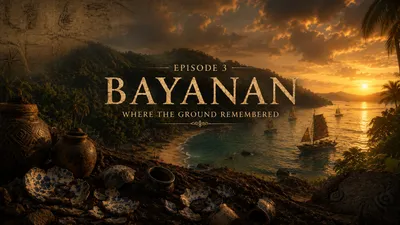
Bayanan and Minolo: Two Places, One Forgotten Archive
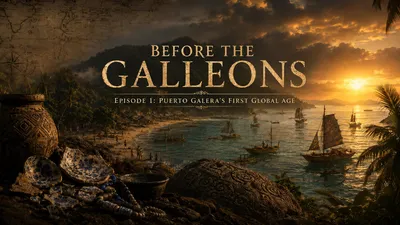
Episode 1 introduced Bayanan as one of Puerto Galera’s major archaeological areas. Episode 2 belongs to Minolo, but the two places should be seen together. The 1964 study by Rosa C. P. Tenazas and Leonisa L. Ramas on trade potteries from Puerto Galera identified Bayanan as the principal source of much of the pottery collection studied, while Minolo was described as another major site. The study connected the finds to trade pottery, burial areas, and native pottery forms comparable with those from Calatagan, Batangas.
This matters because Puerto Galera’s old history is not hidden in one spot. It is spread across a landscape: Bayanan, Minolo, Muelle, the old coves, the hills, the shorelines. The tragedy is that much of this record may have been disturbed before it could be properly protected: pottery collections, looted sites, and recovered fragments suggest some evidence may have been dug up, sold, broken, moved, or forgotten before local heritage protection became serious.
That should make us uncomfortable. Puerto Galera may be sitting on one of the most interesting pre‑Spanish coastal histories in the Philippines — and parts of it may already have disappeared into private collections, family shelves, antique shops, or memory.
Minolo Was Not Isolated
One mistake we must avoid is imagining Minolo as a tiny isolated village suddenly 'visited' by superior foreigners. The better picture is this: Minolo was part of an existing island world. Local people knew the waters, the seasons, the forests, the reefs, the rivers, the winds, and the dangerous places. Foreign merchants may have brought porcelain and other goods, but they needed local knowledge and local exchange networks.
Products traded out of Mindoro did not magically appear on the beach. Someone gathered rattan. Someone collected forest products. Someone knew where shells and corals could be found. Someone hunted, harvested, carried, packed, negotiated, stored, protected, and transported goods. The coast did not function without the interior. The harbor did not function without the people. And the people of Mindoro were not background characters in someone else’s trade story. They were participants.
The Indigenous Layer Beneath the Trade Story
Mindoro’s provincial history says the hinterland of the island is settled by indigenous peoples collectively known as the Mangyans, classified into several ethnolinguistic groups including the Iraya, Alangan, Tadyawan, Buhid, Taubuid, Hanunuo, and Bangon. For Puerto Galera specifically, the Iraya Mangyan are especially important because they are among the northern Mangyan groups connected to this part of Mindoro.
When we talk about forest products entering old trade networks, we should not imagine those products as abstract items from nowhere. They came from landscapes where indigenous communities had deep knowledge. The mountains behind Puerto Galera were lived landscapes. Minolo’s historical meaning likely depended on relationships between shore and mountain, lowland and upland, boat people and forest people. Puerto Galera’s ancient economy was ecological: sea, shore, forest, and mountain worked together.
Why Minolo Disappeared From the Popular Story
So why do so few people talk about Minolo? Simple: later history is louder. Spanish galleons are louder. Muelle Bay is louder. Tourism is much louder. White Beach is basically history’s drunk karaoke neighbor. Modern Puerto Galera became famous for beaches, diving, nightlife, and access from Batangas. The older stories were buried under the branding of paradise. That happens everywhere. Once a place becomes a destination, its past is often flattened into something easy to sell.
But Minolo does not fit the easy postcard.
Minolo asks deeper questions.
Who traded here before Spain?
Who lived here?
Who was buried here?
What objects were placed with the dead?
What routes connected Mindoro to China, Thailand, Vietnam, Sumatra, Java, and other islands?
What did the local people call themselves?
What did foreign sailors hear when they asked the name of the place?
And how much of this evidence is already gone?
That is why Minolo matters.
It turns Puerto Galera from a beach destination into a historical landscape.
The Name as a Doorway
Whether “Mindoro” truly came from Minoro/Minolo, or whether the Spanish “Mina de Oro” explanation became dominant later, the existence of both traditions is valuable.
One story points to gold.
The other points to place.
The gold story tells us what colonizers wanted to see.
The Minolo story tells us where sailors may have gone.
That contrast is beautiful.
Because colonial eyes often saw islands as resources: gold, tribute, labor, land, conversion, control.
But traders and coastal people saw something else: anchorage, exchange, routes, tides, forests, reefs, neighbors, names.
Minolo may be one of those old names that survived just enough to remind us that Puerto Galera’s story did not begin when outsiders renamed it.
A Small Place With a Big Memory
Today, Minolo deserves a stronger place in Puerto Galera’s public memory.
It should be on local history maps.
It should be discussed in schools.
It should be part of heritage tours.
It should be included in serious tourism storytelling.
It should be documented through oral histories, old family accounts, local archaeology, and barangay memory.
Because if Minolo is connected to the old name of Mindoro, and if gravesites near Minolo contained trade goods from the 10th to 15th centuries, then this place is not merely “somewhere near the poblacion.”
It is one of the roots.
A small coastal settlement that may have helped carry the name of an island.
A harbor remembered by traders.
A place where porcelain crossed the sea.
A place where the dead were buried with objects from faraway lands.
A place where old Mindoro looked outward, long before Spain arrived.
Tip or correction?
The Tayo Dito team reviews corrections and extra tips before publication.
Comments
0 comments
No comments yet.
Write the first note. It becomes visible after editorial approval.