
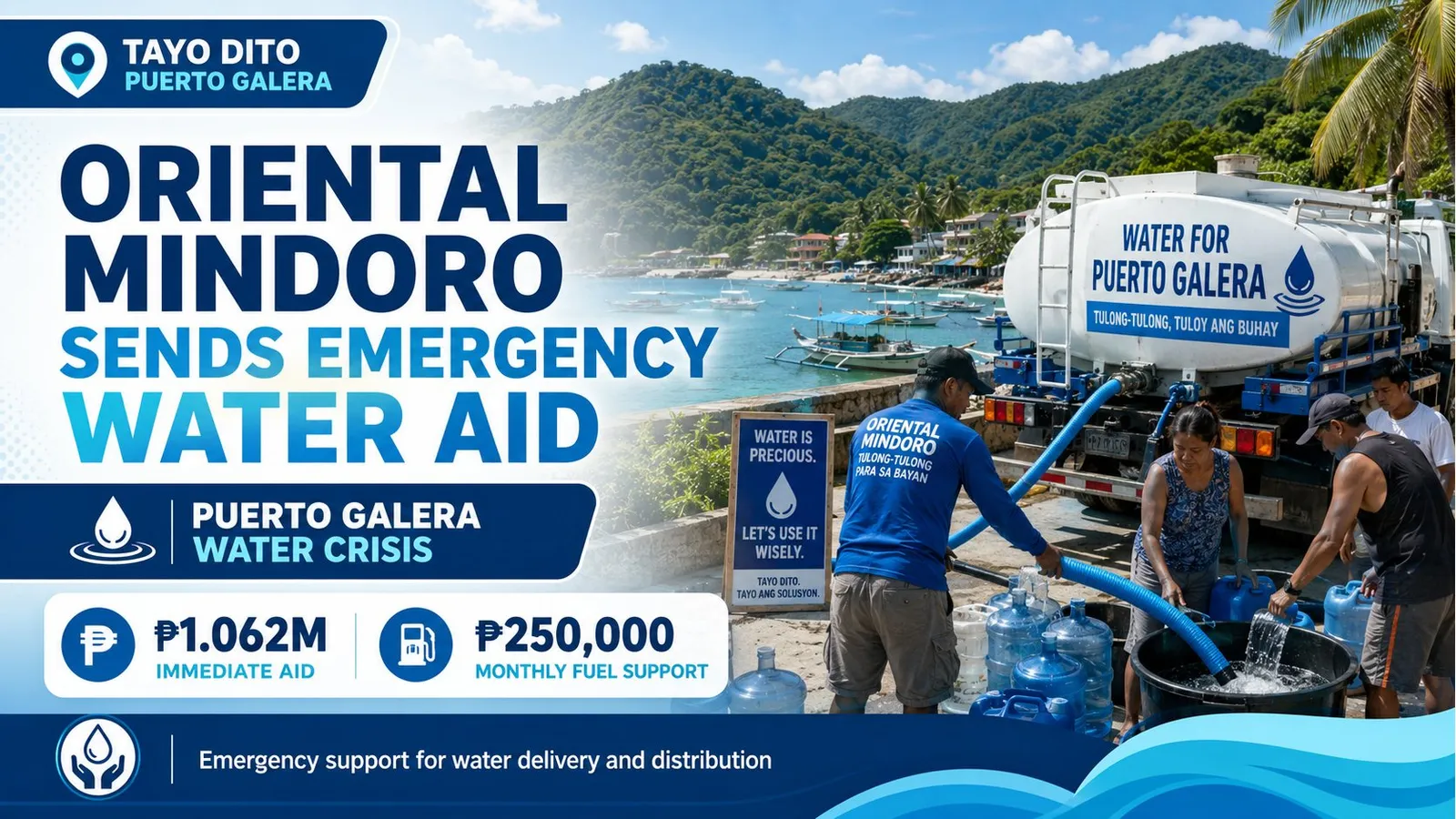
Oriental Mindoro Turns Over ₱1.062 Million in Emergency Aid as Puerto Galera Faces Severe Water Shortage
The provincial government has handed over ₱500,000 for fuel and a one‑kilometre HDPE pipeline worth ₱562,000 to support emergency water deliveries. Officials warn the aid is a stopgap while permanent water solutions are pursued.
Oriental Mindoro turns over ₱1.062 million in emergency aid as Puerto Galera water crisis continues
PUERTO GALERA, Oriental Mindoro — The Provincial Government of Oriental Mindoro has formally handed over more than ₱1 million in emergency assistance to Puerto Galera as the municipality confronts one of its most severe water shortages in recent years.
Governor Humerlito “Bonz” Dolor personally turned over ₱500,000 in financial assistance for fuel together with water‑distribution materials valued at ₱562,000 to Puerto Galera Mayor Robinhood D. Ylagan and Vice Mayor Rocky D. Ilagan on Tuesday, 7 July 2026. The immediate package therefore has a confirmed total value of ₱1.062 million.
In addition, the provincial government has committed to providing another ₱250,000 per month to help finance fuel for water‑delivery vehicles until Puerto Galera’s water supply returns to normal, according to the provincial turnover report.
What was provided and why it matters
The assistance consists of two main parts: a ₱500,000 fuel allocation intended to buy diesel and other fuel for tanker deliveries and emergency response; and one kilometre of 2½‑inch HDPE SDR 9 pipe fitted with compression‑type couplings, valued at ₱562,000. HDPE (high‑density polyethylene) pipe is flexible, corrosion resistant and commonly used to extend temporary or permanent water distribution across uneven terrain.
For communities spread across hillsides, narrow roads and coastal areas, the extra kilometre of pipeline can move water beyond a tanker's unloading point or link a temporary source with local storage and distribution points.
The funds and materials were authorised by a resolution approved by the 12th Sangguniang Panlalawigan during a special session on 23 June 2026 and charged against the province’s Local Disaster Risk Reduction and Management Fund–Quick Response Fund.
Immediate package versus recurring commitment
Some reports described the total assistance as more than ₱1.3 million. That higher figure mixes the immediate ₱1.062 million package with the first monthly ₱250,000 fuel allocation, which together equal ₱1.312 million. The distinction is important: ₱1.062 million was turned over immediately, while the ₱250,000 is a recurring monthly commitment subject to ongoing assessment and the validity of the state of calamity.
If monthly support continues, the cumulative provincial aid would grow—for example, after two months it would reach ₱1.562 million and after three months ₱1.812 million.
Extent of the crisis
Puerto Galera declared a state of calamity after officials reported that large parts of the municipality lacked sufficient access to water. Early Philippine Information Agency reporting put the number affected at about 25,000 residents across 10 of the municipality’s 13 barangays; later provincial reports described impacts across all 13 barangays following the drying of local springs beginning in March 2026.
Officials attribute the shortages to prolonged dry conditions, below‑normal rainfall and weakened spring recharge, compounded by growth in households, businesses and visitors that increased demand on an already strained system.
What emergency aid can and cannot do
The provincial assistance should help sustain and expand costly emergency water deliveries. Fuel funding keeps tankers running; pipe extends distribution reach to areas where tanker access is limited. Puerto Galera has intensified rationing with support from the Bureau of Fire Protection and the Municipal Waterworks System Office, and tankers are being deployed to affected communities.
However, emergency relief does not create new water production. If spring sources continue producing less than demand, the municipality will remain reliant on rationing and outside deliveries until permanent upgrades are completed.
Planned infrastructure steps and outstanding questions
Puerto Galera is pursuing multiple measures to increase supply. Officials plan to rehabilitate four large deep wells constructed previously with national government support; filtration systems are being installed so the wells may be used safely and are expected to provide partial relief to an estimated six or seven barangays once operational.
The town also completed a five‑day geo‑resistivity survey by the Mines and Geosciences Bureau from 1 to 5 July 2026, with preliminary results presented to Mayor Ylagan on 6 July 2026. The survey aims to identify promising locations for exploratory deep‑well drilling.
Authorities and residents caution that further steps—exploratory drilling, pump testing, water‑quality analysis and sustainable yield assessment—are required before new wells can be relied on. Coastal locations also pose a risk of saltwater intrusion if pumping is not managed carefully.
- Rehabilitation of four deep wells with filtration systems (expected to serve six to seven barangays, details pending)
- Geo‑resistivity survey completed 1–5 July 2026 to identify possible drilling sites
- Continued appeals to national government for funding and technical support to build a resilient municipal water system
Local leaders emphasise that a comprehensive solution will require protected sources, verified deep wells, treatment and storage facilities, upgraded pipelines and watershed protection, as well as drought‑response planning.
Impact on residents and tourism
For households waiting weeks for deliveries or buying water from private suppliers, a more reliable emergency delivery operation can offer meaningful relief. But Puerto Galera’s economy—hotels, restaurants, dive operators and other tourism‑related businesses—also depends on a dependable supply. A prolonged crisis risks higher operating costs, lost investment and damage to the town’s reputation as a tourist destination.
The provincial turnover provides short‑term support while municipal and national agencies work toward a permanent solution. Officials say the emergency assistance is a bridge, not a cure, and further investment and technical work will be needed to prevent future crises.
Tip or correction?
The Tayo Dito team reviews corrections and extra tips before publication.
Comments
0 comments
No comments yet.
Write the first note. It becomes visible after editorial approval.