
When we talk about Puerto Galera before Spain, we are not talking about some vague, foggy “ancient times” where everything is mystical and nobody knows anything. We are mainly looking at the period between the 10th and 15th centuries — roughly from the 900s to the 1400s — when northern Mindoro was already connected to Asian maritime trade routes.
Official Oriental Mindoro tourism history describes Puerto Galera as a known trading port from around the 10th century, while archaeological material from Puerto Galera has been linked to trade pottery and burial sites dated broadly from the 10th to 15th centuries. A 1964 study by Rosa C. P. Tenazas and Leonisa L. Ramas also described pottery evidence from Puerto Galera as pointing to several centuries of trade relations with China and other parts of Southeast Asia.
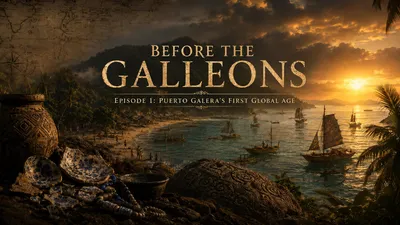
So this story belongs to the centuries before Spanish arrival in Mindoro in the 1570s. It is the world before galleons, before colonial rule, before Puerto Galera received its Spanish name — a world of trade winds, coastal settlements, forest paths, burial sites, boats, ceramics, and goods moving between island communities and foreign merchants.
In that older world, Puerto Galera was not yet a resort town, not yet a diving destination, and not yet the “Port of Galleons.” It was a meeting place. The sea opened the door, the harbor offered shelter, and the island provided goods that foreign traders wanted. From the mountains, forests, rivers, and reefs of Mindoro came products that could be exchanged for ceramics and other goods brought by merchants from abroad.
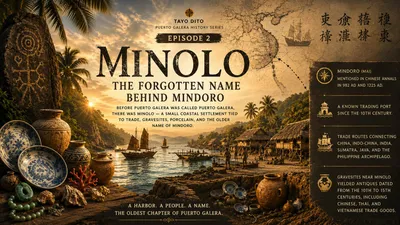
Official Oriental Mindoro tourism history describes Minolo as an old trading center where Chinese merchants exchanged glazed porcelains for local products such as gold, jade, corals, shells, birds, rattan, and other forest goods found on the island.
That list sounds simple at first, almost like an inventory. But hidden inside it is the shape of an entire economy. Gold points toward the inland world of rivers, mountains, and mineral resources. Rattan and forest products point toward upland knowledge, forest trails, and communities that understood the land in ways foreign merchants never could. Corals and shells point toward the reefs and the coastal environment. Birds point toward the richness of the island’s forests. Porcelain, meanwhile, points outward — toward China, Southeast Asia, kilns, ports, ships, and maritime trade routes.
This is what makes the early history of Puerto Galera so fascinating. The town’s oldest economic story was not simply a beach story. It was not only about the sea, and it was not only about the forest. It was the connection between both. Goods from inland Mindoro could move toward the coast. Boats from outside could enter the harbor. Local people could exchange island products for foreign ceramics, ornaments, tools, or other valued objects. The sea and the mountain were not separate worlds; they worked together.
Today, when people think of islands, they often imagine isolation unless there is a ferry route, a bridge, or a strong mobile signal. But in the old maritime world, the sea was not mainly a barrier. For skilled sailors, it was a road. It connected communities, carried goods, spread stories, and linked small coastal settlements to large trading systems. A harbor like Puerto Galera mattered because it gave boats a place to rest, repair, exchange, and wait for safer weather. Its sheltered waters were not only beautiful; they were useful.
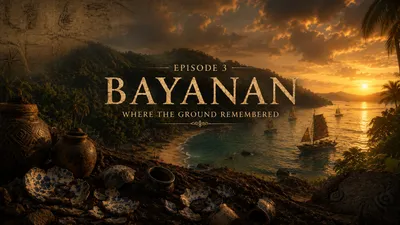
The ceramics found in Puerto Galera help make that connection visible. A porcelain bowl or jar is never just an object when it is found far from where it was made. It becomes evidence of movement. It tells us that something traveled — through ports, across water, from hand to hand, from one world into another. A ceramic vessel may have begun its life in a kiln far from Mindoro, then moved through merchants and sailors before finally arriving on this coast. Once here, it may have entered a household, become a prized possession, been used in trade, or even become part of a burial tradition.
That last possibility gives the story a deeper emotional weight. In the archaeological history of Puerto Galera, trade pottery is not only associated with exchange. Some of it is connected to burial sites. That means these objects were not always treated as ordinary goods. They could carry value beyond daily use. They could become part of memory, belief, family identity, and the way earlier communities honored their dead.
This is where the story becomes more human. It is easy to talk about trade in abstract terms: goods, routes, merchants, products, exchange. But behind every object were people. Someone gathered rattan in the forest. Someone collected shells or coral. Someone knew where valuable products could be found. Someone carried goods down from the hills. Someone negotiated with traders. Someone decided that a porcelain bowl was valuable enough to keep, use, display, or bury with a loved one.
Foreign merchants were important, but they were not the only actors in this story. The old trade of Puerto Galera depended on local knowledge. A trader arriving by sea did not automatically understand the island. He did not know every trail, river, reef, season, danger, resource, or community relationship. Local people did. That is why the story of porcelain and gold should not be told as if outsiders simply arrived and created history. The history was already here. The traders entered a local world that had its own systems, values, and knowledge.
The role of indigenous communities must also be understood in this wider picture. The forests and mountains of Mindoro were not empty spaces behind the coast. They were lived landscapes. They were sources of food, materials, medicine, shelter, stories, and identity. Forest goods mentioned in old trade accounts did not appear by magic at the shoreline. They came from people who knew the land. In northern Mindoro, the Iraya Mangyan and other indigenous communities form part of that deeper historical landscape. Even when the written record is thin, the geography itself reminds us that upland and coastal worlds were connected.
This connection between inland and coast is one of the most important ideas in Puerto Galera’s early history. The harbor made trade possible, but the island made trade valuable. Without the forests, reefs, rivers, and mountains, there would have been little to offer. Without the coastal settlements and boat knowledge, there would have been no easy way to connect those goods to wider markets. The old economy of Puerto Galera was not built on one resource. It was built on movement between different worlds.
Porcelain is the perfect symbol of that movement. It came from far away, but once it reached Mindoro, it became part of local life. It may have sat in a house, been used in a meal, been exchanged again, been treasured as a prestige item, or been placed in a grave. By the time archaeologists and collectors encountered fragments centuries later, the objects had already lived several lives. They had been foreign goods, local possessions, burial objects, broken fragments, and finally historical evidence.
This is why the old ceramics of Puerto Galera matter so much. They are not just pretty antiques. They are proof that this coast was connected. They show that long before European colonial powers tried to control the islands, people here were already participating in Asian trade networks. They also show that the people of old Mindoro were not passive or isolated. They were part of a world that moved by sea, negotiated by exchange, and remembered value through objects.
There is also a quiet irony in this history. Modern Puerto Galera is often marketed through its natural beauty: beaches, coves, reefs, sunsets, and mountain views. But long before those same landscapes became tourism assets, they were part of a working island economy. The reef was not just something to snorkel over. The forest was not just a green backdrop. The harbor was not just a scenic bay. Each had a role. Each produced value. Each helped shape the town’s place in the wider region.
That older economy should make us look differently at Puerto Galera today. The mountains behind the beaches are not decoration. The coast is not only a leisure space. The sea is not only a place for island hopping and diving. These are the same physical elements that made early trade possible. What changed was not the importance of the landscape, but the way people used it.
In the pre-Spanish period, roughly between the 900s and 1400s, the value of Puerto Galera came from exchange. In the Spanish period, beginning in the 1570s, its value came from shelter, control, and maritime strategy. In the modern period, its value comes largely from tourism. But underneath all three periods is the same truth: Puerto Galera has always mattered because of where it sits — between sea and mountain, between local resources and outside movement, between isolation and connection.
The story of porcelain for gold is therefore not just a story about trade goods. It is a story about identity. It reminds us that Puerto Galera was part of a much older Asian world before it was pulled into the Spanish colonial world. It reminds us that the island’s people, resources, and coastal settlements had value long before foreign empires arrived. It reminds us that the first global chapter of this town was not written in Spanish ink, but in clay, shell, gold, forest fiber, boat timber, and broken porcelain.
And perhaps that is the strongest image to keep: a sheltered coast in northern Mindoro, sometime between the 10th and 15th centuries, with boats moving with the wind, forest goods coming down from the hills, ceramics arriving from faraway kilns, local people trading, choosing, adapting, and remembering.
Not a forgotten island.
Not an empty paradise waiting to be discovered.
A living place, already connected, already valuable, already part of history.
Long before Puerto Galera sold rooms to visitors, it traded with the sea.
And long before the galleons came, porcelain had already found its way to the shores of Mindoro.
Tip or correction?
The Tayo Dito team reviews corrections and extra tips before publication.
Comments
0 comments
No comments yet.
Write the first note. It becomes visible after editorial approval.