
Puerto Galera completes geo-resistivity survey as town seeks long-term water sources
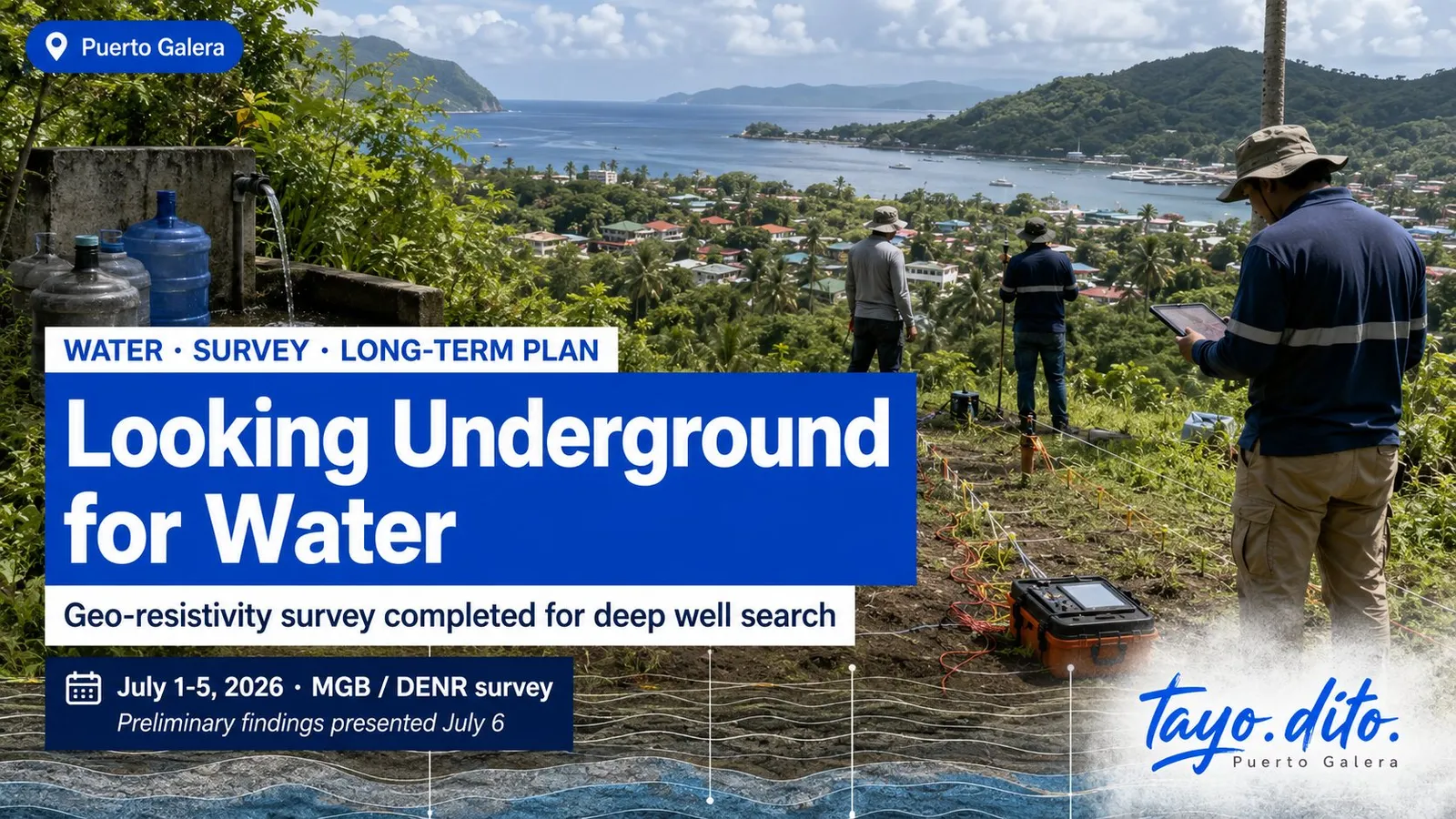
A five-day geo-resistivity survey by the Mines and Geosciences Bureau gives Puerto Galera preliminary leads for possible deep wells as the municipality continues to cope with a severe water shortage.
Puerto Galera has completed a five-day geo-resistivity survey in selected target areas, a key step in the municipality’s efforts to locate new deep wells amid an ongoing water shortage that prompted a declaration of a state of calamity.
The survey was carried out by the Mines and Geosciences Bureau of the Department of Environment and Natural Resources from Wednesday, 1 July to Sunday, 5 July 2026. Preliminary findings were presented to Mayor Robinhood D. Ylagan on Monday, 6 July and will serve as an early guide while the municipality awaits the full technical report from the MGB.
Local officials said the work is part of a broader plan to identify areas with the highest potential for deep-well development. Puerto Galera has been hit by a severe water shortage affecting thousands of residents, which municipal authorities have linked to prolonged dry conditions, reduced spring recharge and the ongoing effects of El Niño.
Geo-resistivity surveying is a non-invasive method that helps geologists 'see' beneath the ground without drilling. Field teams place electrodes in the soil, send a controlled electrical current through the subsurface and measure how different underground materials resist that current. Variations in resistivity can indicate rock, clay, sand, fractured zones, salty water or potential freshwater-bearing layers.
For groundwater projects, the method helps estimate where aquifers might lie and how deep they could be, allowing engineers to prioritise the most promising sites for drilling. The MGB has used similar surveys in other Philippine municipalities to reduce the cost and risk of exploratory drilling.
Municipal officials emphasised that while the survey narrows down where to drill, it does not guarantee successful wells at every site. Drilling without prior study can be costly and risky: a borehole may yield too little water, encounter poor-quality water, or fail completely. The geo-resistivity results aim to reduce that uncertainty and provide a stronger technical basis for decisions.
The water shortage has broad consequences beyond household taps. Businesses, tourism establishments and public services have all been affected. Earlier municipal plans include rehabilitating previously funded deep wells and upgrading the local water system, including filtration facilities, to enhance both supply and quality.
Preliminary results from the MGB survey give Puerto Galera a starting point for possible drilling sites and further technical study. The full MGB report, when released, is expected to identify which areas show the best underground water potential and to recommend next technical steps, including feasibility studies and possible drilling locations.
If the MGB recommendations lead to successful deep wells and system upgrades, Puerto Galera may be able to move from emergency water rationing toward a more stable and reliable water supply—an outcome that officials say is critical for residents, workers and the tourism-dependent local economy.
While the completion of the geo-resistivity survey is a welcome development, it is important to remember that a survey alone does not solve Puerto Galera’s water crisis.
Many residents have long pointed out that the town’s existing water sources depend heavily on springs, rainfall, mountain recharge and shallow water systems. During prolonged dry periods, these sources quickly weaken. This raises an important question: will the proposed deep wells truly reach reliable underground water reserves, or will they only tap the same shallow and seasonal water sources that are already under stress?
Before public funds are spent on new drilling, the community deserves clear answers:
How deep are the proposed wells expected to go?
What is the estimated water yield per day?
Will there be long-term pump testing?
Will water quality be tested independently?
Has the risk of saltwater intrusion been assessed?
Will the full MGB report be made available to the public?
Puerto Galera does not need another short-term patch. The town needs a serious, transparent and science-based water plan that considers population growth, tourism demand, damaged watersheds, old infrastructure and long-term climate conditions.
A successful survey may help point the way. But only honest planning, proper testing and accountable implementation will bring real water security to Puerto Galera.
Tip or correction?
The Tayo Dito team reviews corrections and extra tips before publication.
Comments
0 comments
No comments yet.
Write the first note. It becomes visible after editorial approval.