
When people speak about the early history of Puerto Galera, the story often begins at the coast. It begins with boats, traders, porcelain, burial sites, old harbors and the sheltered waters that later gave the town its Spanish name. That coastal history is important. Without the sea, Puerto Galera would not have become a trading point, a galleon refuge or a tourism center.
But the sea is only half of the story.
Behind the coves and beaches rise the mountains of northern Mindoro. Behind the harbor are forests, rivers, ridges, footpaths and upland communities whose history is older than colonial maps and modern resort brochures. To understand Puerto Galera before Spain, we must look not only at what arrived by boat, but also at what came down from the hills.
That is where the Iraya Mangyan enter the story.
The Iraya are one of the Mangyan groups of Mindoro, and they are closely connected to the northern part of the island. A study on the customary justice system of the Iraya Mangyan places Iraya communities in Puerto Galera, San Teodoro and Baco in Oriental Mindoro, as well as parts of Occidental Mindoro. The same study specifically mentions fieldwork among Iraya Mangyan communities in Talipanan in Puerto Galera and in villages of Baco.
This matters because Puerto Galera’s older history is not only a maritime story. It is also a mountain story. It is a story of people who knew the forest, the rivers, the plants, the trails, the seasons and the land long before outsiders began naming, mapping and selling the coast.
The Mountains Were Not Empty
Modern tourism often turns landscapes into scenery. The beach becomes a background for photos. The mountain becomes a green wall behind the resort. The forest becomes “nature.” The people who lived there before the tourism economy are easily pushed into the margins of the story, if they are mentioned at all.
But historically, the mountains behind Puerto Galera were not empty.
They were lived spaces.
They were sources of food, medicine, building materials, weaving materials, forest products, shelter and spiritual meaning. They were crossed by footpaths, remembered through place names, and understood through generations of local knowledge. For communities such as the Iraya Mangyan, the upland world was not a backdrop. It was home.
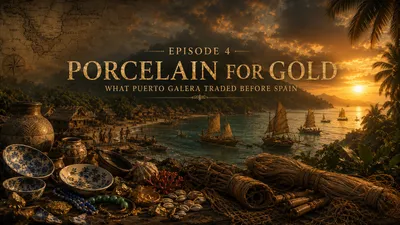
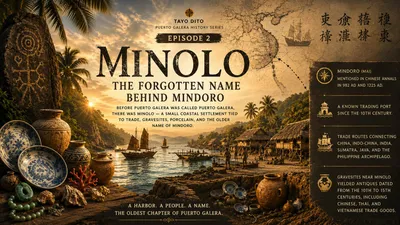
This is why the earlier trade history of Puerto Galera cannot be explained only from the shoreline. Historical accounts describe Minolo as a trading place where Chinese glazed porcelain was exchanged for local products such as gold, jade, corals, shells, birds, rattan and other forest goods. The coastal exchange may have happened near the harbor, but many of the products that made Mindoro valuable came from the wider island environment — from reefs, rivers, forests and upland areas.
A foreign merchant arriving by boat could bring porcelain. He could not bring local forest knowledge. He did not know every trail, every plant, every source of fiber, every seasonal danger, every river crossing, or every local relationship required to move goods from the interior to the coast. That knowledge belonged to the people of the island.
So when we speak about “trade,” we are not only speaking about merchants and boats. We are also speaking about the hidden labor and knowledge that made exchange possible.
Coast and Upland Belonged Together
Puerto Galera’s pre-Spanish trade world likely depended on movement between different landscapes. Goods from the forest could move toward the shore. Marine products could move inland or outward. Imported ceramics could enter local households or burial traditions. The old economy was not divided neatly into “coastal people” and “mountain people” as if they lived in separate worlds without contact.
The connection between lowland settlements and upland communities has deep historical importance across Mindoro. The Iraya Mangyan customary justice study explains that after Spanish arrival, Mangyans who refused Hispanization moved further inland while still maintaining economic contact with lowland communities through forest goods.
That sentence is important. It tells us two things at once.
First, Spanish colonization changed the social geography of Mindoro. Communities that did not accept Spanish rule, religion or lowland colonial structures often withdrew deeper into the interior. This was not because the mountains were empty and waiting. It was because the mountains offered refuge and continuity.
Second, movement inland did not mean total isolation. Economic contact continued. Forest goods still moved. Exchange still happened. Relationships between upland and lowland worlds remained part of the island’s life.
That helps us understand Puerto Galera more honestly. The coast may have become the visible face of the town, but the inland world remained part of its foundation.
The Iraya Mangyan Are Not a Footnote
One of the mistakes often made in local history is treating indigenous peoples as a short introductory paragraph before the “real” history begins with Spain. That is upside down.
The indigenous layer is not the introduction.
It is the foundation.
The Spanish period is a later chapter. Tourism is an even later chapter. The presence of Mangyan communities belongs to an older continuity of Mindoro’s human landscape. It predates Spanish rule and survives into the present.
Modern demographic data confirms that this is not only ancient history. According to PSA MIMAROPA’s 2020 census data for Puerto Galera, Indigenous Peoples identified by NCIP made up about 14.9 percent of the municipality’s household population. Among these groups, Mangyan-Iraya was by far the largest, with 4,513 persons, representing 72.6 percent of the IP population counted in Puerto Galera.
That means the Iraya Mangyan are not merely a historical memory. They are a living part of Puerto Galera today.
The same PSA report shows how important this becomes at barangay level. In Baclayan and Villaflor, Mangyan-Iraya was the dominant ethnicity recorded in the 2020 census.
So if Puerto Galera wants to tell its own history properly, it cannot tell only the story of Muelle, Minolo, Bayanan, Sabang and White Beach. It must also tell the stories of Baclayan, Villaflor, Talipanan and other communities where the older memory of the land remains alive.
Talipanan and the Public Face of Iraya Culture
For many visitors, the most visible encounter with Iraya Mangyan culture in Puerto Galera is the Mangyan village in Talipanan. Travel Oriental Mindoro describes Talipanan Mangyan Village as a cultural site where visitors can see Iraya Mangyan handicrafts, including baskets, bags and household items made from nito, rattan and other natural materials.
This is valuable, but it must be approached with care.
Handicrafts are not just souvenirs. They are expressions of material knowledge: how to recognize useful plants, when to harvest, how to prepare fibers, how to weave, how to pass techniques from one generation to another, how to turn the forest into objects of beauty and utility.
A basket is not “just a basket.”
It is landscape knowledge made visible.
A woven item carries the memory of hands, plants, patience and inherited skill. It is easy for a tourist to buy one in a few minutes. It may have taken generations for a community to preserve the knowledge behind it.
That is why any local platform should avoid reducing the Iraya Mangyan to a tourist stop. Talipanan is important, yes, but Iraya history is larger than a village visit. It includes land, language, memory, justice systems, family structures, economic survival, displacement, adaptation and the continuing challenge of protecting culture in a fast-changing tourism town.
Customary Justice and Living Tradition
The Iraya Mangyan customary justice study is especially useful because it shows that Iraya culture is not only about visible crafts or clothing. It also includes systems of conflict resolution, social order and community authority. The paper focuses on cases where customary justice was invoked among Iraya Mangyan communities and examines why the system still continues.
That matters because outsiders often only notice what is easy to photograph. A basket can be photographed. A village gate can be photographed. A performance can be photographed. But law, memory, conflict resolution, kinship, respect and moral authority are harder to see.
Yet those invisible systems are often the deepest parts of culture.
A community survives not only because it preserves objects, but because it preserves relationships. It knows how to settle disputes, how to respect elders, how to transmit knowledge, how to define responsibility, and how to keep social balance under pressure from the outside world.
In a place like Puerto Galera, where tourism, land pressure and outside money have changed the town dramatically, these systems matter even more. They are not museum pieces. They are survival tools.
Spanish Arrival and the Retreat Inland
When the Spanish arrived in Mindoro, they did not simply add a new name to the map. They changed power.
They brought missions, tribute, administrative control, military pressure and new settlement patterns. Coastal and lowland communities were easier to reach, convert and govern. Upland communities had more room to resist, withdraw or negotiate from distance.
The Iraya Mangyan study explains that Mangyans who refused Hispanization retreated further into the interior while continuing economic contact with lowlanders through forest goods.
This is one of the most important historical ideas for Episode 5.
The mountains became more than home. They became protection.
They became a place where older ways could continue beyond the direct reach of colonial authority. That does not mean life was easy. Retreat often comes with pressure, loss, displacement and reduced access to coastal resources. But it does mean that upland geography helped preserve cultural continuity.
In Puerto Galera, this gives the landscape a deeper meaning. The mountains are not simply beautiful. They are historical refuge. They are cultural memory. They are part of the reason older identities survived.
The Trade Story Looks Different From the Mountain
If we view Puerto Galera only from the sea, we see boats arriving.
If we view it from the mountain, we see goods descending.
That change in perspective matters.
From the sea, porcelain is the exciting object. It arrives from far away, shiny and foreign, carrying the prestige of distance.
From the mountain, the more important question is: what did Mindoro give in return?
Forest products. Rattan. Birds. Possibly resins, fibers, timber, food, and other goods that required local environmental knowledge. The island was not passive. It was productive. It was valuable. It had resources that outside traders wanted.
The Iraya Mangyan and other upland communities were part of the human geography that made that value possible. Even where direct archaeological links are difficult to prove for every specific product, the broader relationship is clear: forest-based goods require forest-based knowledge. And that knowledge belonged to people living with the land.
This is why Episode 5 belongs in the series after the trade episodes. It adds the missing half. Porcelain came by sea, but many exchange goods came from land. Without the upland world, the coastal trade story is incomplete.
A Living People in a Changing Town
Puerto Galera has changed brutally fast compared with the long rhythm of indigenous history. Roads, resorts, land sales, tourism, migration, internet culture, real estate speculation, environmental pressure and public infrastructure have all reshaped the municipality.
In this modern setting, the Iraya Mangyan face the challenge of remaining visible without being reduced to decoration.
Visibility can help. It can support livelihood, cultural pride and public recognition. But visibility can also become shallow if outsiders only want the “nice” parts: handicrafts, dances, photos, village visits and souvenir shopping.
Real respect goes deeper.
It asks about land. Education. Health. Language. Cultural transmission. Livelihood. Representation. Fair trade. Access to services. Protection from exploitation. Participation in decisions that affect ancestral areas and community life.
A local history series cannot solve all of that. But it can begin by telling the story properly.
Not as pity.
Not as exoticism.
Not as a tourist attraction.
As history.
As continuity.
As part of Puerto Galera’s identity.
The Older Memory of the Land
The phrase “older memory of the land” is not poetry only. It is a useful way to understand what the Iraya Mangyan represent in Puerto Galera’s history.
The coast remembers trade.
The harbor remembers ships.
The burial sites remember ceramics.
The mountains remember people.
They remember paths that existed before roads. They remember plants known before imported goods. They remember communities that survived outside the center of colonial power. They remember ways of settling disputes, making objects, reading the environment and living with the forest.
That memory is not locked in the past. It continues in people, families, skills and communities today.
This is why the Iraya Mangyan should not be placed at the edge of Puerto Galera’s story. They belong near the center.
The town’s history is not complete without them.
Why This Matters Now
Puerto Galera is often presented to the world through water: beaches, bays, reefs, dive sites and sunsets. That image is not false, but it is incomplete.
The deeper story is a meeting of sea and mountain.
The old trade economy depended on that meeting. The Spanish period reshaped it. The tourism economy now profits from it. But the indigenous communities of northern Mindoro remind us that the land itself has memory older than all of these later systems.
For Tayo Dito, this matters because local media can do something tourism brochures usually do not do. It can slow the story down. It can name the people. It can give context. It can show that Puerto Galera is not just a destination but a layered historical landscape.
The Iraya Mangyan are not the “other” history of Puerto Galera.
They are part of the main history.
Before the galleons, before the resorts, before modern roads, before the town became famous outside Mindoro, the land was already known, used, remembered and lived in.
And if Puerto Galera wants to understand itself, it must listen not only to the sea.
It must listen to the mountain.
Tip or correction?
The Tayo Dito team reviews corrections and extra tips before publication.
Comments
0 comments
No comments yet.
Write the first note. It becomes visible after editorial approval.